
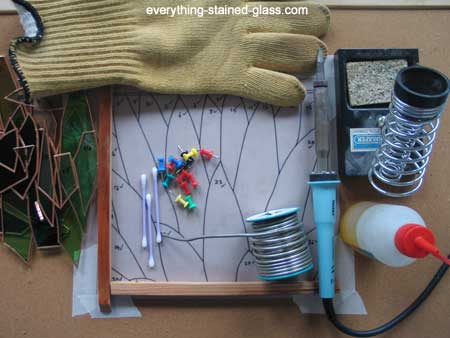
Lead free stained glass solder … the usual reaction is that it’s dull, lumpy and hard to use. But is it possible to use lead free solder for stained glass successfully?
The truth is that it IS a bit trickier to use than leaded solder. The good news is that, with practise and by implementing a few basic principles, you’ll be able to produce work equally as beautiful as before.
And you’ll be able to market your work as safe for customers to enjoy.
When To Use Lead Free Solder
If you’re not sure whether you need to use lead free solder, ask yourself if people handle the stained glass you make.
It’s best to use lead free solder for projects that are touched or worn. These include stained glass jewellery, kaleidoscopes, boxes and any other giftware.
What Is Lead Free Solder Made Of
I often get asked if lead free solder really IS lead free.
The answer is ‘yes’.
It was developed by industry in an attempt to move away from lead solders that are potentially bad for health and the environment.
All solders are types of metal alloys (mixes) and lead free solder is no exception. It’s just that lead has been removed from the equation.
Instead of the 60/40 tin/lead we’re used to, lead free solder is a mix of either tin/copper or tin/copper/silver. Small amounts of Bismuth and Antimony can also be found in some lead free solders.
So you can be reassured; lead free solder for stained glass is exactly that – lead free.
Best Lead Free Solder For Stained Glass
As a result of the higher tin content (and silver if used), lead free solder is more expensive to buy.
There is a silver lining to this though; lead free solder is less dense than leaded which means you get more length of solder wire for your money. To be exact, you’ll get 14% more feet of wire with a 1lb spool. Every little helps these days.
The lead free solders that contain silver flow better and have greater tensile strength. They may be worth the extra money if these characteristics are important for you and your project.
There are several lead free solders for stained glass on the market from a variety of manufacturers. As is usual in stained glass, there are many variables that affect results. Your best bet is to try a couple out for yourself and see which works best for your own particular set up.
Here are a few pointers for you:
Amerway
Amerway’s lead free stained glass solder comes in 3 varieties; Ruby, Tourmaline and Emerald. 2 out of the 3 work well for stained glass.
1. Ruby 97/3 – tin/silver
Unsurprisingly, with the silver content, this is 1st of the 2 Amerway products that works well with stained glass. It flows easier and is therefore easier to work with. It has a lower melting point and is stronger.
2. Tourmaline 99.3/0.7 – tin/copper
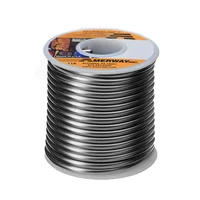 This solder has been specifically created for stained glass and gives a shinier finish. The flow is less good than Ruby but the results are great.
Available on Amazon here (Paid link)
3. Emerald 97/3 – tin/copper
This one is harder to use with less successful results for stained glass.
Victory White Metal
Victory White Metal has a stained glass specific lead free solder product:
1. No Lead Super 50 – 97/3 tin/copper
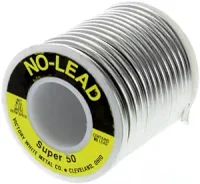 As long as you turn your iron up sufficiently it flows well and creates a decent bead.
As a bonus, it works well for sculpting if you don’t increase your iron’s heat.
Available from Amazon here (paid link)
2. Victory White Metal also offer a ‘lead free plus’ solder which contains silver
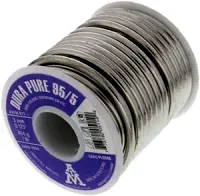
I haven’t tried this so can’t comment but would guess that it’s shinier and easier to use as a result of the silver content. Oh, and more expensive of course 🙂
You can see it on Amazon here (paid link)
Canfield
Canfield’s range of lead free solder rightly has a very good reputation, especially for stained glass jewelry making. Unfortunately the relatively high cost of their products puts people off purchasing.
In their defence, all Canfield’s lead free solders contain silver which makes them more expensive to manufacture than those made of just tin and copper.
1. DGS Lead-Free Solder – tin/copper/silver
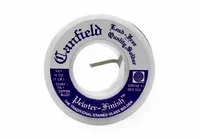 You can get a good flow with this solder and create a decent bead. It has a lower melting temperature which makes it easy to work with.
You can buy it on Amazon here (paid link)
2. Pewter Finish Lead Free – tin, silver and copper
This lead free solder gives a matt finish that mimics antique pewter. It’s said that it behaves similarly to 50/50 tin/lead. This is the solder to choose if you want a more antique look.
I haven’t used it so can’t comment with any authority but if I know stained glassers, I KNOW that they like a good shiny finish, LOL.
Best Lead Free Solder For Stained Glass Jewelry
Canfield’s Silvergleem is the outright winner when it comes to lead free solder for stained glass jewelry.
1. Silvergleem 96/4 – Tin/Silver
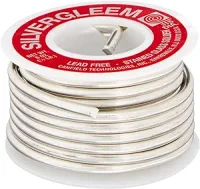 This is a great lead free solder. With 4% silver (the highest silver content of any lead free solder) it’s no surprise that Silvergleem gives a shinier finish and works equally well for beaded and decorative solder seams. It flows in a similar fashion to 50/50 tin/lead solder. It’s shiny finish can be buffed and left or it can be patinaed and waxed. It looks good even after coming into contact with skin and lotions.
Available on Amazon here (paid link)
Using Lead Free Solder For Stained Glass
Lead-free solder does not flow as nicely as 60/40 or 50/50. Bear in mind it reacts more like 50/50. Worry not, with practise, and patience, you can run a very nice solder bead with lead-free solder.
- A clean tip before you start is essential for lead free solder for stained glass. It’s a good idea to have 2 tips; 1 for leaded soldering and 1 for lead free to avoid mixing the two.
- Keep cleaning your iron tip as you go to prevent it gunking up.
- The 2 most important things to remember when soldering lead free stained glass are MORE HEAT and MORE FLUX.
TEMPERATURE
The reason for needing a high heat is that lead free solders have a higher proportion of tin which has a higher melting point. Lead-free solder melts about 20 to 45 degrees C higher than 60/40 solder.
Consequently it takes extra heat to make it flow nicely.
You need to have a hotter iron than you usually use when running a bead. I can’t be specific here as all irons are different and the way people approach soldering varies greatly.
Turn your iron up from the temperature you usually use for beading a seam. For example, if you were using a Hakko at 410C, turn it up incrementally to 460C (centigrade) to work out which temperature works best for your particular set up.
If you have a Weller with a 7 (700F) tip, you’ll need to invest in an 8 (800F) one to achieve a higher temperature.
When running a bead, it will be helpful to work slowly, which allows the solder to heat up a little more. Have your iron tip flat to the solder to transfer as much heat as possible.
As usual, be aware that there’s a balance to be had here; you can crack the glass if you dwell too long in one place. Let it cool and return if necessary.
FLUX
Lead free solder is known not to flow as easily as leaded solder. As a result it requires more flux than normal to help it flow.
Gel flux is a good bet as it doesn’t create so much toxic fumes and doesn’t evaporate so quickly.
Dipping your solder in flux as you solder is a way of ensuring that you apply enough flux to achieve a good flow.
Using Patina With Lead Free Solder
The patina you use for 60/40 or 50/50 solder won’t work on lead free solder because it’s formulated to work on tin and lead.
If you want to patina lead-free solder you’ll need a patina for silver. Midas Black Max from Rio Grande is one brand. You or your supplier should be able to order it, or you can check out jewelry making companies for similar.
Whether or not you use patina, make sure you finish up with a finishing compound or wax to prevent oxidation as normal and keep your solder looking its best.
Is Lead Free Solder Better Than Leaded Solder?
Certainly, there are safety and environmental benefits. And if you are making stained glass objects that will be handled, it’s a necessity.
With practise (and more heat and flux!) you can produce solder of a similar standard with lead free solder.
That said, you don’t need to use it for pieces that aren’t touched. Your best bet is to learn how to use it and choose the most appropriate solder – leaded or lead free – according to the project.
Good luck and share any more tips you have with everyone in the Comments Section below. Thanks 🙂
Try a trick from electronics world, obtain a curly s/steel pan scrubber( the type that looks like turning shavings) take a small tin ex bean or similar about 1.5ins deep. loosely scrunch the pan scrubber put it in the tin. Dip the soldering iron bit into the sctubber before each run,move it around until bright, get on with soldering, always clean tip before switching off
Do not file an iron tipped bit , if it gets that bad, buy a new bit. Higher wattage irons will be needed to work with lead free solder.
I learnt to solder anything to anything as an appentice repair silversmith and have applied that knowledge to various work over the years.
That’s so helpful Peter, thanks for sharing your expertise. Good tip about the bean can; ingenious 🙂
I’m new to stain glass. I want to use as non toxic materials as possible. I bought lead free solder and a non toxic flux . My iron I have up to highest temp and tried seeing if it worked well. I took pice a paper to see if it burned through, it did. My iron tip doesn’t hold a ball of solder. Is my tip bad ? Do I need a special tip when using lead free solder? Any info on the solder tool what’s the best kind and lead free solder etc. would greatly appreciate any info ty!
An iron tip would always burn a bit of paper Ing, so it’s hard to compare that to solder. You don’t need a special tip for lead free.
I’m wondering if your soldering iron is powerful enough. If it’s one that’s a dedicated stained glass iron, then I’ll assume it is. If not, check the wattage to make sure it reaches a high enough temperature to melt solder. 360C minimum.
The tip may need cleaning. Keep it clean as you go by wiping it on a damp sponge and keep adding flux too.
You need to tin the tip when you first start using it – https://www.youtube.com/watch?v=GaevzrSYrx0
HI! I am working on stained glass using lead-free lead and I also use Hakko! From some point on, when soldering is performed, the lead cools and turns white. Not only is it not glossy, but it also turns black when applied with a polish. I really dont know why and my all works has been stopped. Can you help me?
It is a bit difficult Alice. Use lots of flux, a warmer iron and solder as quickly as you can. Remove flux as soon as you can afterwards.
Hi, I’ve been making little stained glass airplant holders with regular 60/40. I’ve been wondering, if I wanted to make more of a planter, where soil would be placed into it, would I need to use lead free or aquasafe solder? Considering plants would need to be watered and there would be moisture on the pieces regularly?
Thanks!
I’ve never been asked or thought about that before Emily! Interesting thought. I guess now I have been asked that it would seem kind to use lead free 🙂
What about came ? What came do you use for lead free stained glass.?
Hi Jessica, it’s an interesting question! There isn’t a lead free lead came. You can use zinc of course but it doesn’t bend at all easily.
Sorry I don’t have a magic solution 🙁
There is a lead free came from canfield ” diamond lead free came” bends easy and looks shiny
I make stained glass jewelry using lead-free silver solder. I have a hakko fx-601 soldering iron that I use. I use studio pro flux and studio pro lead-free solder. I recently ordered a new brand of copper tape (can’t remember the brand name now!) because I’ve been having issues with the copper tape slightly peeling up once the solder is applied. It ever so slightly curls away from the glass around the edges. I was hoping with a new brand of tape this problem would go away, but I am still having this issue. Has anyone else experienced this? I wrap the pieces quite well, using a fid. I inspect each piece to make sure the tape is flush before applying the flux and then the solder. I would be SO grateful for any insight on how to fix this problem! If anyone has other brand suggestions for solder and flux, I would appreciate that as well!
Annoying isn’t it Emmalee. I have a really comprehensive list of why foil isn’t sticking on this page. Good luck with it, don’t give up!
Just getting into stained glass, I do not wish to work with lead for obvious reasons. Does anyone have recommendations on patina for lead free projects??
If you want to patina lead-free solder, you will need a patina for silver. Midas Black Max is one brand. The patina you use for 60/40 or 50/50 solder does not work, because it is formulated to work on tin and lead. Your supplier should be able to order it, or you can look at jewellery making companies like Rio Grande.
Whether or not you use patina, be sure to finish up with a finishing compound or wax to prevent oxidation and keep your solder looking its best. I hope that helps Destiny.
Thanks for all this excellent information! I am getting back into stained glass work after decades and am working with my son who I don’t want exposed to lead. I am making panels for a snake vivarium as well and don’t want to expose our python to lead. I bought the items Dennis recommended and am just curious as to what tip to use on the Hakko iron – 601 comes with a thick wide tip that has an angled slice that looks like a good match for stained glass work but I also ordered tip T19-D5/P. Is it better to use the 3/16” angled tip or a pointed one? More surface area with a hot iron and hard to melt solder makes good sense to me.
Thanks all!
Yes, I’d agree, you want a decent sized surface area to transfer more heat. I’d suggest 1/4″ or 3/8″ for beaded seams. I have more info on this here: https://everythingstainedglass.com/hakko-fx-601temperature-question.
Good luck and thanks for your kind comments about the site.