
Silver Staining Tips
Silver nitrate is used to stain glass and was discovered in the early 14th century.
It is composed of silver nitrate and gamboge gum, and comes in various colours, from pale yellow to a rich orangey-amber.
It differs from paint and enamels because during firing a chemical process takes place in which the stain becomes part of the molecular structure of the glass, rather than adhering to the surface.
Want to learn how to make stained glass?
The tutorial page here covers the copper foil technique in easy stages.
Before you start
- If you are painting and staining the same piece of glass, painting must be done first and fired before staining takes place.
Why? Because stain fires at between 1022F/550C – 1040F/560C. This is 212F/100C lower than the paint firing temperature. If you fired them at the same time, the silver stain will overfire. This creates an unpleasant bloom on the surface.
- Stain is applied on the opposite side to the paint.
Why? Because stain permeates the glass and is prevented from doing so if paint is already fired onto the surface.
Test firings
The colour of the fired stain is very unpredictable. It is always a good idea to do tests if you require a particular shade or hue.
Some glass resists stain almost completely.
There are four main elements that influence colour results:
- the top temperature of the firing schedule – the hotter it is, the deeper the colour
- the amount of time the firing cycle takes – the slower the firing takes, the darker the color
- the thickness of application – the thicker the application, the darker it becomes
- the type of glass used
Equipment needed
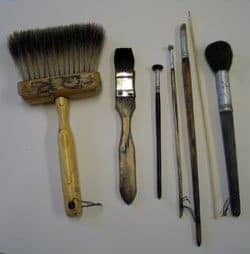
Silver nitrate, water, palette, palette knife, badger, mop and various brushes.
Applying silver stain
Just before applying stain it is helpful to dampen the glass or lightly wet the tips of the badger brush.
This gives you more time to manipulate silver nitrate before it dries, and it prevents hard edges by allowing you to blend the colour more subtely.
– Stain can be applied directly with a brush, or blended with a badger like paint.
– You can create dark and light areas by blending from thick to thin respectively.
– You can use a variety of brushes and tools to apply the stain directly, depending on the marks and textures you are aiming for.
Cleaning
Always clean brushes with water immediately after using stain. The stain is corrosive and will start to destroy the ferrules of brushes and palette knives if left for any length of time.
Kiln Firing Schedule
Stain fires between 1022F/550C – 1040F/560C.
If it is fired more than once, it intensifies in colour. Unfortunately, this doesn’t mean that if a piece of glass is resisting stain, that repeated firings will solve the problem.
Helpful Resources
This is a really helpful 2 minute video showing how to silver stain. It’s using the blending, rather than painting method.
Video showing how to stain glass with silver nitrate
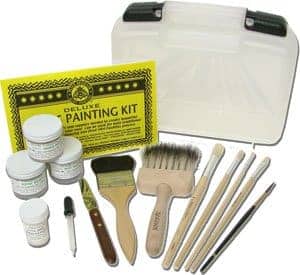
This painting starter kit is available on Amazon
This painting starter kit is available on Amazon Peter Mcgrain Deluxe Paint Starter Kit (paid link)
Hi Milly
My silver stain has come out patchy my – can I remove the Silverstein in any way or improve it?
Many thanks
Zoë
You can’t remove it as it becomes part of the molecular make up of the glass. You can apply more and re-fire.
I always suggest testing each glass before you fire the real thing as stain really is idiosyncratic.
Good luck
What is the firing schedule. How long at what temp.
The firing range is between 550-560 C – see above in the article for Fahrenheit conversion. I talk about firing in the article and how the temperature depends on what results you’re seeking.
Firing schedules also depend on the behaviour of your kiln and the size of glass you’re firing. This is why I’m not willing to give specifics on schedules; everyone has to test their own kilns.
Quite odd.
You quote “Because stain fires at between 1022F/550C – 1040F/560C. This is 212F/100C lower than the paint firing temperature. If you fired them at the same time, the silver stain will overfire. This creates an unpleasant bloom on the surface.”
And then show a video which quotes the firing temperature as 650C
Eagle eyes Phillip and a good observation, thanks. Different glass ‘takes’ stain differently and needs experimentation – as they say in the video. I use mainly handmade glass which in my experience has needed a lower temperature than they suggest.
Thanks for pointing this out; I hadn’t registered it and see the different information is confusing. I hope that explains it.